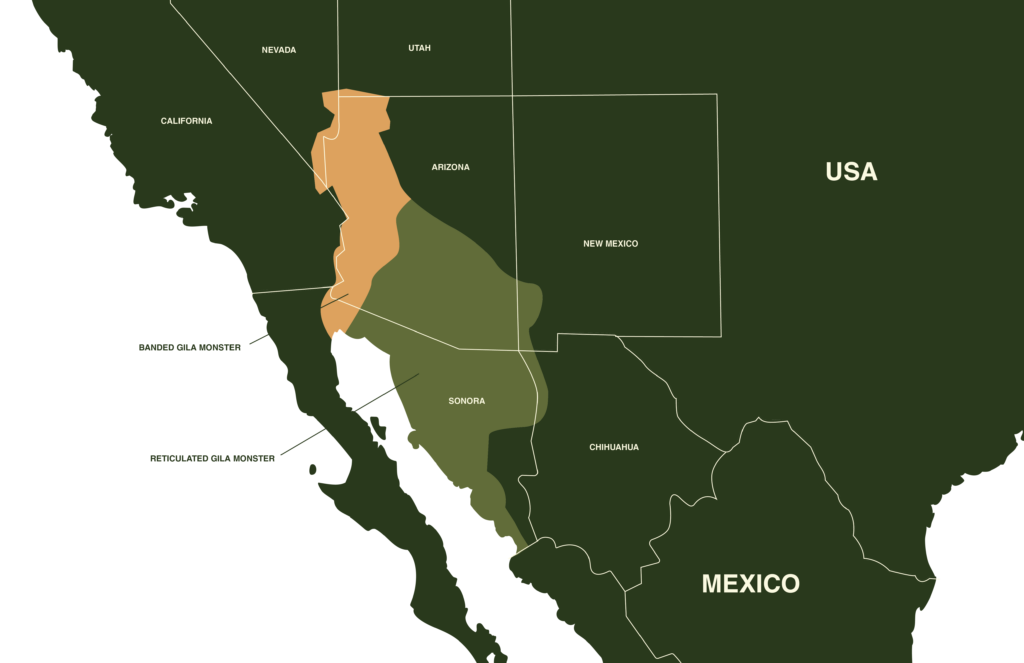
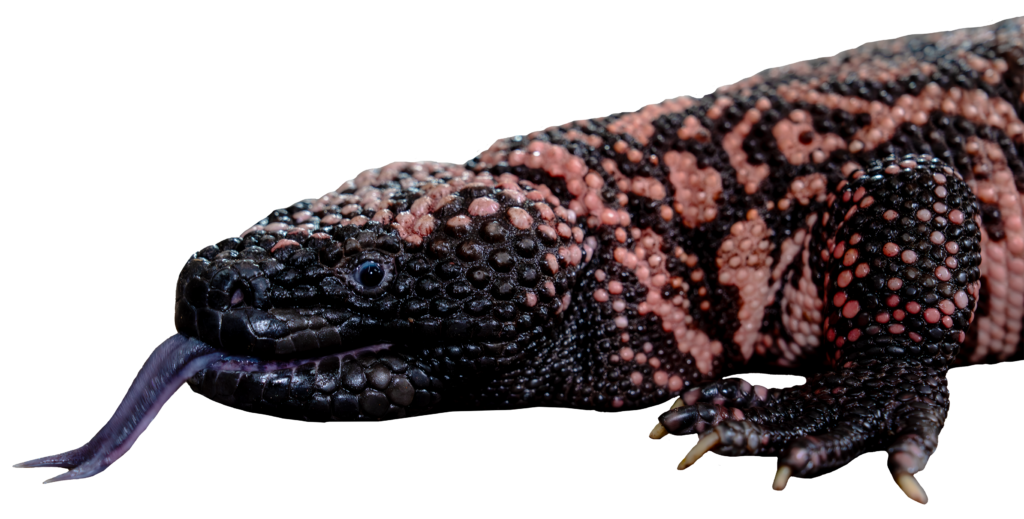
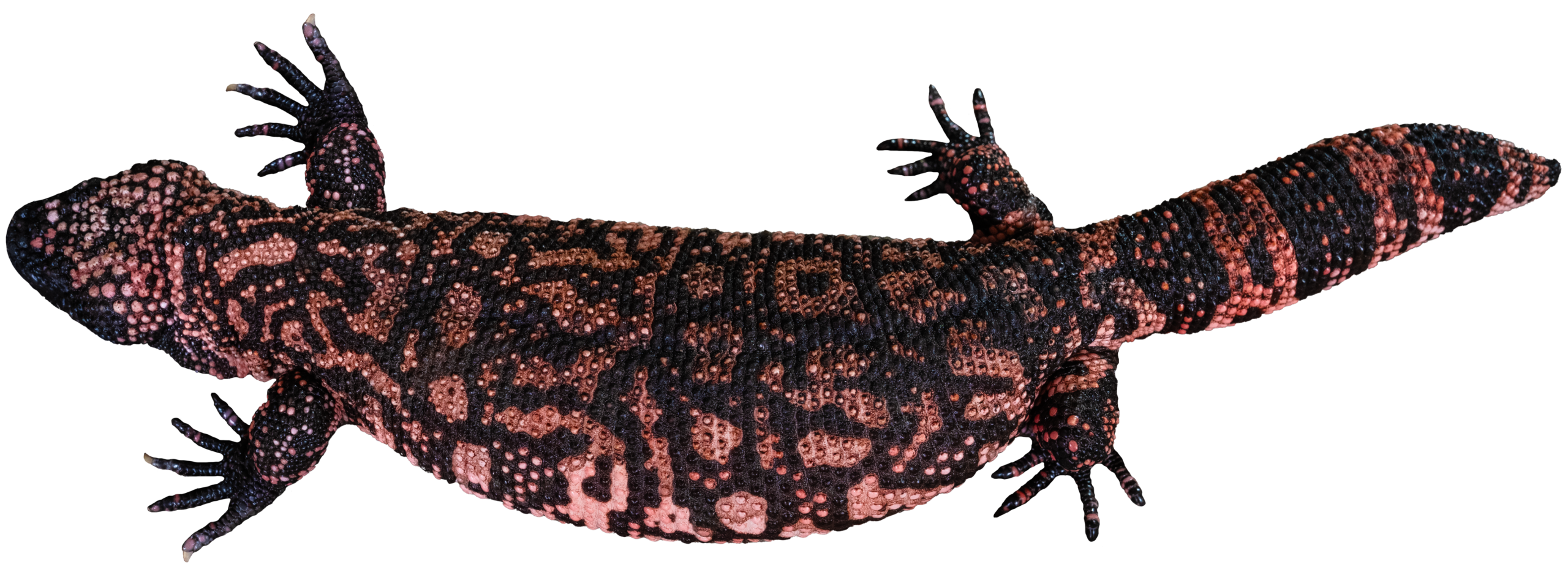
The Gila Monster is native to the southwestern United States and northwestern Mexico, including Arizona, southern California, southern Nevada, Utah, New Mexico, and the Mexican state of Sonora. They range from sea level up to 5,000 feet in elevation, preferring areas with sufficient moisture to support shrub life, such as rocky foothills, scrubland, succulent desert, oak woodland, and arroyos. They seek shelter in burrows they dig themselves or those abandoned by other animals, as well as under rocks and in thickets. They spend an estimated 90–98% of their lives underground.
CHARACTERISTICS
In the wild, Gila Monsters typically live 20–30 years. They grow 12–22 inches long and weigh up to 0.8–1.5 pounds. Females lay 2–12 eggs in July or August, but the eggs do not hatch until the following spring; one of the longest incubation periods of any lizard, lasting approximately 10 months. This strategy allows hatchlings to emerge during favorable conditions.
They are active foragers that use their keen sense of smell to locate prey, flicking their forked tongue to collect scent molecules and transferring them to the Jacobson’s organ on the roof of their mouth. They are capable climbers and will scale trees to raid bird nests. They can consume up to one-third of their body weight in a single meal, allowing them to eat infrequently. They are carnivorous opportunists, feeding on small mammals, birds, eggs, snakes, frogs, insects, carrion, and lizards; exhibiting cannibalistic tendencies. Eggs are a particular favorite; they can locate and dig up eggs buried up to 6 inches deep. They can store water in their urinary bladder and reabsorb it during dry periods, providing about 80 days of hydration. Their slow metabolism allows them to thrive in harsh desert environments with scarce food resources.
VENOMOUS LIZARD
The Gila Monster is one of only two known species of venomous lizards in the world, the other being the Mexican beaded lizard, and they are the only venomous lizard native to the United States. Scientists believe their venom evolved mainly for defense rather than hunting, as their prey does not require venom to subdue; the intense pain caused by a bite serves as a powerful deterrent to predators. Once a Gila Monster bites, they clamp down with a vise-like grip and often hold on tenaciously, sometimes flipping over to allow venom to flow into the wound. Unlike venomous snakes that inject venom from the upper jaw, Gila Monsters produce venom in modified salivary glands in the lower jaw. They lack the musculature to inject venom; instead, they chew it into the victim through grooved teeth.
LIVING FOSSIL
The Helodermatidae family has remained relatively unchanged for millions of years. The genus Heloderma has existed since the Miocene epoch (about 10 million years ago), and similar lizards date back to the Cretaceous period (145 to 166 million years ago).