
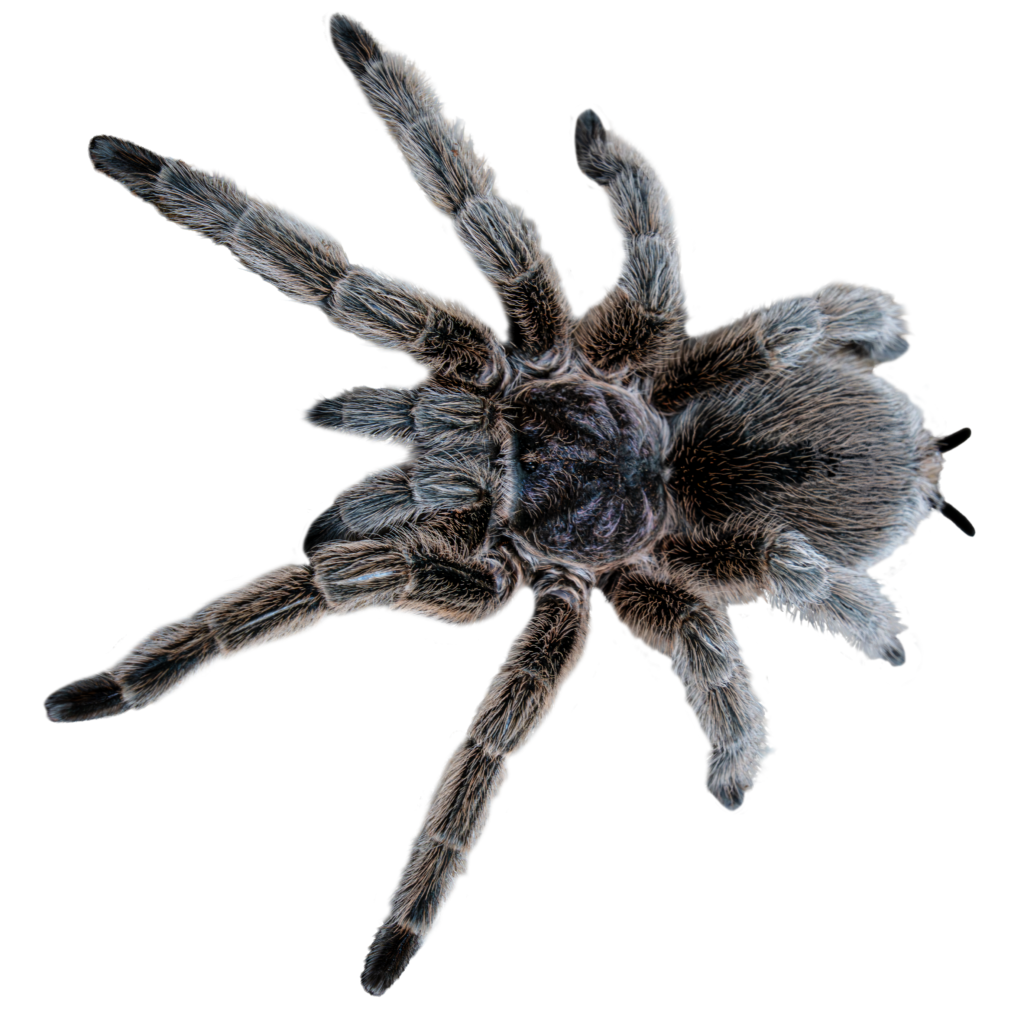
Chilean Rose Tarantula
- Class: Arachnida
- Order: Araneae
- Family: Theraphosidae
- Scientific Name: Grammostola rosea
- Class: Reptilia
- Order: Squamata
- Family: Iguanidae
- Scientific Name: Ctenosaura pectinata
GEOGRAPHY
The Chilean Rose Tarantula is native to the desert scrub and high desert regions of northern Chile, as well as parts of Bolivia and Argentina. They are terrestrial and fossorial species that inhabit arid to semi-arid scrublands and grasslands. In the wild, they dig shallow burrows, often under stones or vegetation, or take over abandoned rodent burrows, lining them with silk. Their burrows are typically straight-down and occupied by a single solitary individual. Unlike many tarantulas that stick close to their burrows, the Chilean Rose is known as a “wanderer” and will travel great distances to find new shelter or food, which is unusual for the genus.

CHARACTERISTICS
The Chilean Rose Tarantula is an ambush predator. They do not use webs to catch prey but instead pounce on victims that pass by their burrow or hiding spot. As opportunistic carnivores, their diet consists of various insects such as crickets, cockroaches, grasshoppers, beetles, and caterpillars. They will occasionally take small lizards and rodents. They are primarily nocturnal, resting in their burrows during the day and hunting at night.
They are venomous and use their venom primarily to subdue their prey. When they capture an insect or small vertebrate, they sink their fangs into the victim and inject a potent cocktail of neurotoxins and digestive enzymes. This venom quickly paralyzes the prey and begins breaking down its internal tissues into a liquid “soup” that the tarantula can then suck up through their straw-like mouthparts. While their venom is not considered medically significant to humans, it can cause localized pain, swelling, and, in rare occasions, an allergic reaction. When threatened, they are reluctant to bite and prefer to flick their urticating hairs as a defense mechanism. These barbed hairs can cause itching, skin rashes, and even eye damage if they come into contact with sensitive areas.
The Chilean Rose Tarantulas are very long-lived. Females have a lifespan of 15–20 years in captivity, and some have been known to live over 25 years. Males have a much shorter lifespan, typically living only 2–4 years after reaching maturity. They are a moderately large, heavy-bodied tarantula, with a leg span that can reach up to 6 inches.
Male Chilean Rose Tarantulas have a short biological clock. Once they have their final molt, they have less than a year to find a mate or they will die of old age. Males develop tibial hooks (spurs) on their front legs and bulbous tips on their palps to aid in mating. They will find a female’s burrow and perform a courtship display. If the female is receptive, the male uses his tibial hooks to hold her fangs back while he inseminates her. Male tarantulas risk being eaten by the female after mating, the male must make a very fast retreat to survive. Females produce an egg sac containing a large number of eggs. Clutch sizes can range from 50 to over 1,000 eggs. She guards this cocoon aggressively until the spiderlings hatch.
BLACK AND WHITE EYESIGHT
It is not a myth that male tarantulas risk their lives to mate. A female is a solitary, territorial predator, and a potential mate is just another large creature in her space. In this species, as in many others, the male must use his specialized tibial hooks to hold her fangs back to avoid being eaten before, during, or after the mating process. After a successful copulation, the male must make a very fast retreat. Females are incredibly prolific, laying an egg sac containing up to 2,000 eggs. She will guard this sac fiercely in her burrow, protecting her countless offspring with unwavering dedication.
RECORD-BREAKING HEART RATE
The resting heart rate of a Chilean Rose Tarantula is about 40 beats per minute, roughly half the average resting heart rate of a human. However, when actively hunting or facing a threat, their heart rate can spike dramatically to over 200 beats per minute. For a tarantula, this surge of oxygenated blood powers their muscles for rapid strikes, quick escapes, or the sudden explosion of defensive hairs.