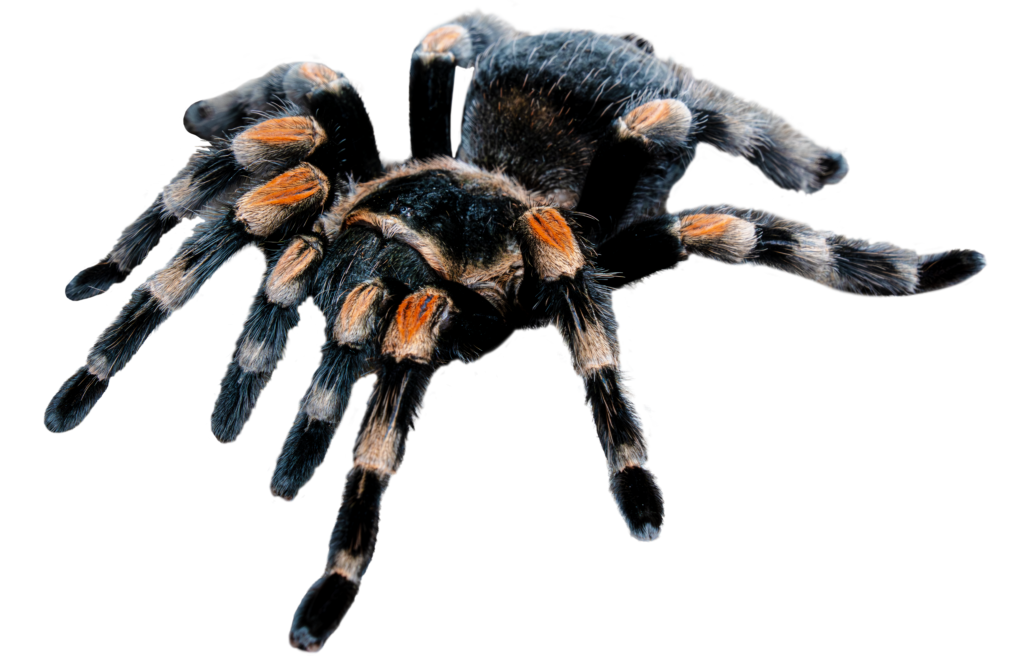
Mexican Red Knee Tarantula
- Class: Arachnida
- Order: Araneae
- Family: Theraphosidae
- Scientific Name: Brachypelma hamorii or Brachypelma smithi
- Class: Reptilia
- Order: Squamata
- Family: Iguanidae
- Scientific Name: Ctenosaura pectinata
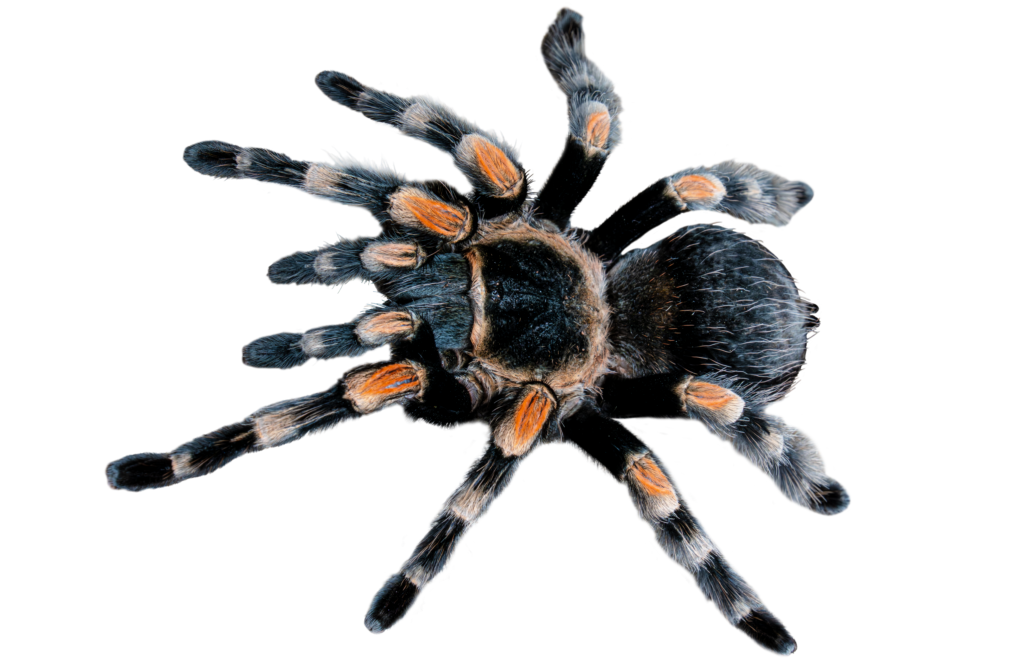
Taxonomic Note: The term “Mexican Red-Knee” actually refers to two virtually indistinguishable species: Brachypelma hamorii and Brachypelma smithi. For many years, they were considered the same species. It wasn’t until 1997 that researchers began distinguishing them, and DNA barcoding in 2017 confirmed they are genetically distinct. To the average eye, they look nearly identical—the differences are found in subtle morphological traits and genetics.
GEOGRAPHY
The Mexican Red Knee Tarantula is endemic to Mexico, found along the Pacific coast. They are a terrestrial, fossorial species that inhabits dry tropical deciduous forests, scrublands, deserts, and thorn forests. They live in burrows they dig themselves or modify from existing cavities under rocks, logs, and tree roots. Their burrows can be multi-chambered and extend about three times their leg span in length.

CHARACTERISTICS
Mexican Red Knee Tarantulas are nocturnal hunters and solitary except for mating. They are carnivorous ambush predators that feed on large insects, frogs, and small mice. They detect prey through vibrations sensed by specialized hairs on their legs, rush out of their burrow to bite it, and return to the safety of the burrow to consume the liquefied victim.
Mexican Red Knee Tarantulas are famous for being extremely docile and are the most popular beginner tarantula for this reason. They are more likely to kick hairs than bite. When they do bite, the venom is mild, equivalent to a bee or wasp sting, but their large fangs can cause painful puncture wounds. Their primary defense is to kick barbed hairs from their abdomen, which can cause severe irritation and a painful rash on skin. If these hairs get into eyes, they can cause serious irritation, a powerful deterrent for predators.
They grow slowly and are exceptionally long-lived. Females can live 25–30 years, while males live a much shorter 5–10 years . Females reach sexual maturity at 6–7 years; males mature earlier at 4–5 years. During mating, the male uses special spurs (tibial hooks) on his front legs to lock the female’s fangs open, preventing her from biting him during copulation. Females produce a massive egg sac containing 200–400 eggs (up to 700 in some cases). She carries the egg sac between her fangs and guards it fiercely until the spiderlings hatch.
UNORTHODOX PREY
In the wild, the Mexican Red-Knee has a terrifying predator: the tarantula hawk wasp. This huge wasp will vibrate at the entrance of the tarantula’s burrow, mimicking the vibrations of prey to lure the spider out. When the tarantula emerges, the wasp stings them with a paralyzing venom, drags them back to a burrow, and lays an egg on their still-living body. The wasp larva then hatches and slowly consumes the tarantula alive.
DEADLY MYTHS
In parts of Mexico, locals have an irrational fear of these tarantulas, and some reportedly kill them on sight, even pouring gasoline into their burrows. This fear is deeply rooted in myth, as these spiders are extremely docile and their venom is no more dangerous than a bee sting.
The origins of these fears run deep in Mexican cultural history. In pre-Hispanic Mexico, spiders were associated with powerful deities; Mictlantecuhtli, the lord of the underworld Mictlán, and various feminine divinities who were patrons of weavers and spinners, an important guild in ancient Mexico. On certain stelae, spiders accompanied the tzitzimime, supernatural beings who were said to devour humanity at the end of the world. This made spiders objects of both reverence and fear in ancient civilizations.
With the Spanish conquest and the arrival of Judeo-Christian religion, and the concept of supremacy over animals, brought new ideologies. Spiders became symbols of esotericism, evil, devilish creatures, deceit, sin, temptation, and greed. Tarantulas, due to their large size and grotesque appearance, provoked particular fear among humans, and they were erroneously considered dangerous animals.
These ideas have unfortunately been passed down through generations and bad reputations through media; especially film, television, and now social media. In some regions of southern Mexico, such as Chiapas, tarantulas are called “yerbas” and are accused of making livestock sick, especially horses; a practice known as “enyerbar.” The myth claims that the tarantula scrapes the hair around a horse’s hoof and uses it to line their hiding spots, and that their saliva or urine causes the hoof to rot and fall off. This is, of course, completely false, the disease in horses’ hooves is caused by bacteria that proliferate during rainy seasons and has no connection to tarantulas. Beyond specific myths, Mexican red-knees are sometimes seen as “horse-killers” based on similar folklore.
The combination of cultural implications, colonial native ideologies, and modern media has brought misunderstanding to this incredible docile species. A misfortune that unfortunately damages the existence of these beautiful arachnids.